
2026 Top Types of Floating Docks for Global Buyers
Floating Docks are no longer limited to private marinas or calm residential lakes. In 2026, global buyers need solutions matched to water conditions, traffic levels, budgets, and maintenance capacity. This guide introduces the main floating dock types, including modular plastic systems, aluminum frames, timber platforms, concrete pontoons, and steel structures. Each option offers different strengths.
A dock that performs well on a sheltered lake may struggle in strong currents or tidal water. Details matter. Wave exposure, flotation capacity, freeboard, connection hardware, and walking surface safety all deserve careful review. We will compare these factors through a practical procurement lens, not through attractive product photos alone. Real installation experience shows that access for repairs can be as important as initial price.
The discussion also considers commercial marinas, waterfront developments, fishing facilities, resorts, and temporary work platforms. Buyers should examine technical drawings, buoyancy calculations, material specifications, warranty terms, and documented project references. Supplier communication matters too, especially when drawings, delivery schedules, and local installation requirements cross language barriers. Conditions change. No single design wins everywhere.
Some comparisons may remain imperfect because site data is often incomplete before purchase. That limitation deserves honest attention. The most reliable decision combines professional engineering advice, verified manufacturer information, realistic operating loads, and a clear maintenance plan. By understanding how each Floating Docks type behaves in its intended environment, international buyers can reduce avoidable costs and choose a platform that remains stable, usable, and serviceable over time.
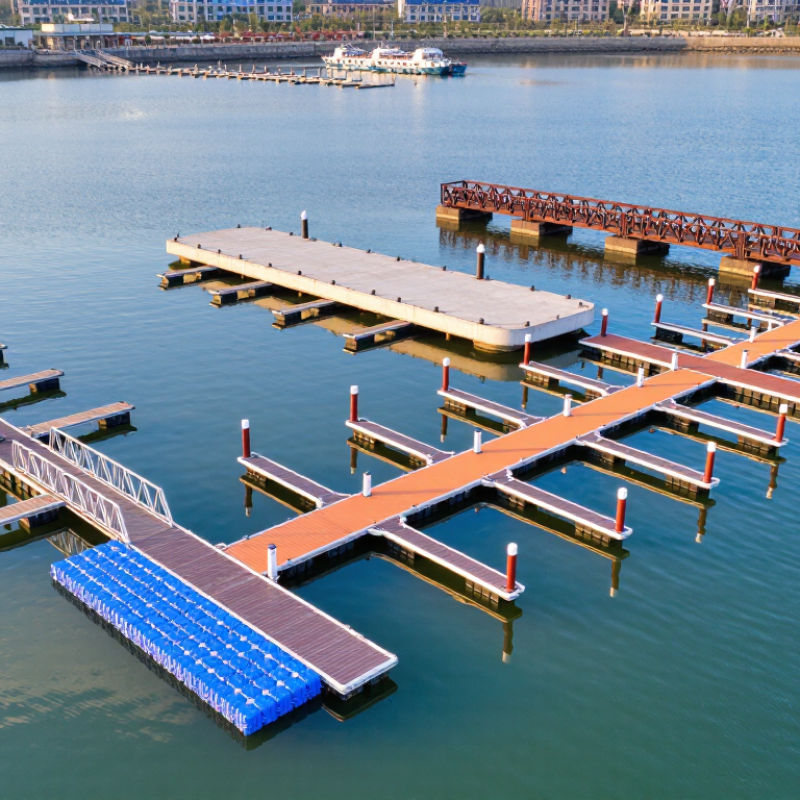
Floating Dock Basics and How They Work
2026 Top Types of Floating Docks for Global Buyers
Floating Dock Basics and How They Work
A floating dock stays above water through buoyancy. Its floats displace water equal to the dock’s total weight. The structure usually includes float modules, a supporting frame, decking, connections, and access ramps. When people, boats, or equipment add weight, the dock settles slightly lower. This movement is normal.
The frame spreads loads across several floats. Hinges or sliding connections allow the dock to rise and fall with changing water levels. Anchors, guide piles, or tension lines limit sideways movement. In calm lakes, simple anchors may work well. Rivers and coastal areas often require stronger systems because currents, wind, and waves create uneven forces.
Deck height matters. Adequate freeboard keeps splash water away from the walking surface. A rough, slip-resistant deck also improves safety during rain. Load calculations should include users, stored equipment, and local weather conditions. No estimate is perfect. An oversized boat or crowded platform can expose weak assumptions quickly. Regularly check bolts, hinges, float chambers, and anchor lines for wear. Small cracks deserve attention before winter ice or storms enlarge them. A dock may appear stable while one connection quietly carries too much stress. That detail is easy to miss.
2026 Top Types of Floating Docks for Global Buyers - Floating Dock Basics and How They Work
| Floating Dock Type | Basic Construction | How It Floats | Typical Buoyancy Capacity | Typical Deck Height | Best-Suited Applications | Main Advantages | Important Limitations | Key Buying Considerations |
|---|---|---|---|---|---|---|---|---|
| Modular Plastic Cube Dock | Interlocking high-density polyethylene cubes or panels with molded connectors and optional aluminum or galvanized-steel accessories. | Sealed plastic flotation modules displace water and generate upward buoyant force. Individual modules can be added or removed to adjust capacity and layout. | Approximately 120–250 kg per 500 mm × 500 mm module | About 300–500 mm above the water | Small marinas, swimming platforms, rowing access, temporary events, boat boarding areas and recreational waterfronts. | Lightweight, easy to assemble, corrosion-resistant, expandable and convenient to transport. | Less suitable for heavy permanent loads, high wave exposure or frequent impact from large vessels unless properly engineered. | Check UV stabilization, connector strength, slip resistance, module load rating, replacement availability and local water-level changes. |
| Aluminum-Framed Floating Dock | Marine-grade aluminum beams and decking supported by sealed polyethylene, foam-filled or rotationally molded flotation units. | Flotation units provide displacement while the aluminum frame distributes walking, equipment and berthing loads across the dock. | Approximately 250–600 kg per 1 m section, depending on flotation volume | About 400–700 mm above the water | Residential docks, light commercial marinas, kayak launches, fishing platforms and moderate-use access systems. | Good strength-to-weight ratio, low maintenance, modular configuration and relatively easy installation. | Aluminum can deform under severe impact, and dissimilar-metal contact may cause galvanic corrosion if connections are not isolated. | Review alloy and coating specifications, frame deflection, decking material, connection hardware, freeboard and wind or wave design loads. |
| Steel-Framed Floating Dock | Welded hot-dip galvanized or coated steel frame combined with foam-filled pontoons, sealed floats or other buoyancy chambers. | Large flotation bodies support the steel structure, while the rigid frame transfers concentrated loads from vehicles, equipment or vessels. | Approximately 500–1,500 kg per 1 m section, depending on pontoon volume and frame design | About 500–900 mm above the water | Commercial marinas, service docks, work platforms, floating bridges and locations requiring higher structural stiffness. | High rigidity, strong impact resistance and good performance for demanding commercial applications. | Heavier transport and installation requirements; coatings, welds and submerged components require regular corrosion inspection. | Verify corrosion protection, weld quality, structural calculations, lifting points, ballast arrangement and maintenance access. |
| Concrete Pontoon Dock | Reinforced concrete shell or deck integrated with an enclosed low-density core, sealed flotation chamber or prestressed structural system. | Water displacement from the pontoon body creates buoyancy. The broad, heavy platform reduces motion and improves stability in exposed conditions. | Typically engineered for 500–2,000+ kg per linear metre | About 500–1,000 mm above the water | Permanent marinas, passenger access, heavy-use berths, utility platforms and locations requiring low movement. | Excellent stability, long service life when properly designed, high impact resistance and low vibration. | Very heavy and expensive to transport; installation generally requires specialized lifting or towing equipment. | Assess water depth, foundation and anchoring system, concrete durability, freeze-thaw exposure, wave climate and installation logistics. |
| Pontoon Dock with Cylindrical Floats | Wood, aluminum or steel deck frame supported by two or more cylindrical polyethylene, steel or aluminum pontoons. | Parallel pontoons displace water and carry the deck load. Additional pontoons can increase capacity and stability. | Approximately 300–1,200 kg per 1 m section | About 400–800 mm above the water | Boat mooring, fishing docks, floating work areas, access walkways and medium-duty recreational facilities. | Simple load path, good availability of standard components and flexible pontoon spacing. | Rounded pontoons may provide less lateral stability than wide modular systems, particularly in wakes or crosswinds. | Compare pontoon diameter, wall thickness, foam filling, end-cap design, frame spacing, freeboard and anchoring requirements. |
| Foam-Filled Floating Dock | Structural frame fitted with closed-cell expanded polystyrene or similar buoyant foam enclosed by a protective skin or pontoon shell. | Closed-cell foam continues to provide buoyancy even if the outer skin is locally damaged, although capacity depends on the protected foam volume. | Approximately 250–900 kg per 1 m section | About 350–700 mm above the water | Permanent private docks, swimming platforms, work floats and moderate-duty marina walkways. | Reliable reserve buoyancy, reduced risk of sudden sinking and good resistance to water absorption when correctly enclosed. | Exposed foam can be damaged by impact, ultraviolet radiation, solvents or animals; protective covering must remain intact. | Confirm foam density, water-absorption performance, shell durability, repair method, fire requirements and environmental compliance. |
| Inflatable Floating Platform | High-strength coated fabric tubes or chambers with an inflatable deck, drop-stitch panels or removable rigid accessories. | Air-filled chambers displace water. Internal pressure and multiple independent chambers help maintain shape and reserve buoyancy. | Approximately 100–400 kg per 1 m², depending on pressure and construction | About 150–350 mm above the water | Temporary swimming areas, leisure platforms, rescue support, water sports and seasonal events. | Compact storage, low transport cost, rapid deployment and low draft. | Vulnerable to puncture, abrasion, sharp objects, pressure changes and prolonged exposure to extreme weather. | Check chamber redundancy, fabric weight, seam quality, inflation pressure, repair kit, anchoring points and operating temperature range. |
| Floating Bridge or Walkway System | Linked pontoon sections with a continuous deck, handrails, transition ramps, hinges and anchoring or guide-pile components. | Multiple connected flotation units distribute pedestrian loads while hinges allow the walkway to follow water-level changes and moderate wave motion. | Typically engineered for 250–500 kg per m² pedestrian live load | About 300–800 mm above the water | Marina access, lake crossings, rowing facilities, emergency access and temporary waterfront infrastructure. | Provides safe linear access, accommodates changing water levels and can be extended in sections. | Hinges and ramps experience concentrated forces; excessive slope, current or wave action can affect accessibility and safety. | Evaluate live load, ramp slope, handrail height, walkway width, hinge movement, emergency egress, anchoring and accessibility standards. |
Note: Buoyancy values are indicative engineering ranges rather than universal specifications. Final capacity, freeboard, stability and anchoring must be verified using the actual dock dimensions, live loads, vessel loads, wave conditions, current, wind, water-level variation and applicable local regulations.